 FLAGSHIP
Gaia Sentinel
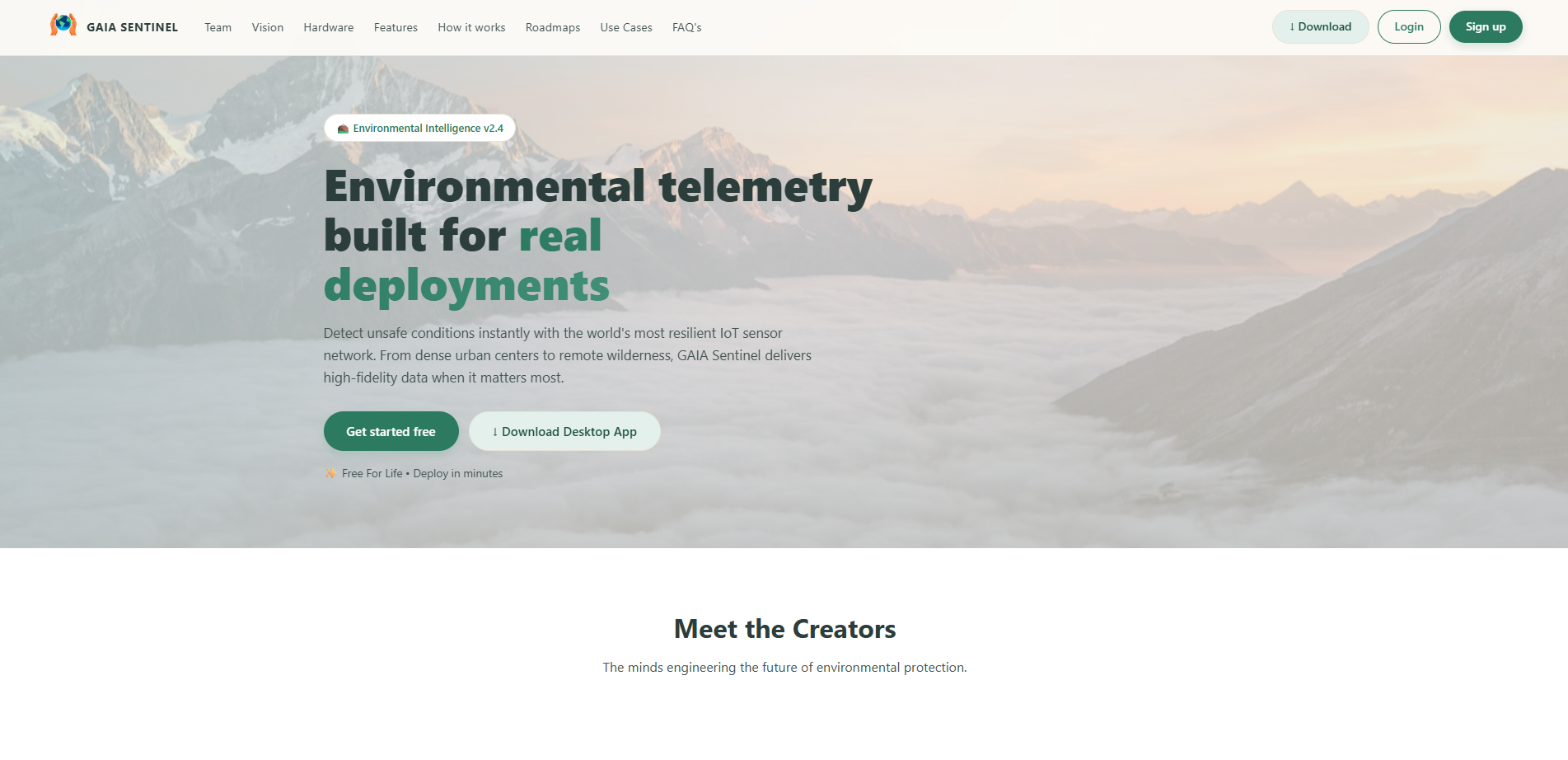
Environmental monitoring using IoT sensor networks. Custom hardware that reads air and water quality in real time and pushes alerts when things go bad.
Gaia Sentinel is an environmental intelligence platform we started as a school project. The idea was simple: traditional environmental monitoring is too slow. Lab tests take 48-72 hours. By the time you know there's contamination, the damage is done. We built sensor nodes that detect unsafe conditions in sub-second latency and alert you instantly. The platform monitors PM2.5, PM10, NO2, carbon monoxide, TDS, pH, and water temperature. Data flows from hardware nodes through our Python/Flask backend into a real-time WebGL dashboard. We won first place at Robo Genesis in December 2025 for this. Right now we're working on a HEPA Purification Node — it doesn't just measure pollution, it actively cleans the air when thresholds are crossed. 100 cubic meters per hour, industrial-grade HEPA-13 filter with activated carbon.
- Air quality monitoring — PM2.5, PM10, NO2, CO via laser-scattering sensors
- Water quality monitoring — TDS, pH, turbidity analysis
- Intelligent alert system — Low / Medium / Critical classification with SMS and email
- Real-time WebGL dashboard with CSV/JSON export
- Multi-platform: web console, mobile responsive, REST API
- AES-256 encryption, role-based access control, GDPR compliant
- Store-and-forward: nodes cache data locally for 30 days if internet drops
- Air Node — MQ135, MQ7, MQ2, MQ4, MQ6, DHT22 sensors. 5G & LoRaWAN mesh. IP67 weatherproof.
- Water Node — TDS and water temperature sensors. IP68 fully submersible. 2+ year probe life.
- Drone Attachment — < 150g modular payload. Universal DJI/Autel mount. Real-time 3D pollution heatmapping.
- HEPA Purification Node — 100 m3/hour capacity. AI-autonomous activation. Industrial HEPA-13 + activated carbon.